What Japanese Concepts Can Teach Us About Overthinking
We often find ourselves replaying conversations, analysing decisions, or imagining every possible outcome. While it can feel all-consuming, overthinking isn't a sign that something is wrong with us.
It's often a sign that our brains are doing exactly what they're designed to do, trying to solve problems and reduce uncertainty. The challenge is that not every problem can be solved by thinking alone. Sometimes, the more we analyse, the more stuck we become. Have you found this to be true?
If so, there are several well-known Japanese concepts that can offer us a different perspective. Rather than trying to eliminate difficult thoughts, they encourage us to focus on purpose, curiosity, gradual progress and balance.
Some of these ideas share common ground with evidence-based therapies such as Acceptance and Commitment Therapy (ACT), Cognitive Behaviour Therapy (CBT), behavioural activation and mindfulness.
Ikigai – Finding Meaning Rather Than Certainty
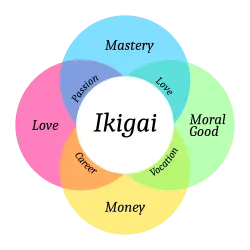
Ikigai is often translated as "a reason for being" or "a reason to get up in the morning."
Contrary to the popular Venn diagram frequently shared online, traditional ikigai isn't necessarily about your finances, or finding the perfect career or relationship.
It can be be found in everyday moments that bring meaning and connection.
For one person, it might be raising children.
For another, it may be helping others through work.
For someone else, it might simply be walking the dog each morning or tending to a garden.
When we're overwhelmed by uncertainty, our minds naturally search for answers. Purpose offers us something different, it gives us somewhere meaningful to direct our attention.
Psychological research consistently shows that having a sense of purpose is associated with greater wellbeing and resilience. While it won't eliminate anxious thoughts, it can help us move towards a life that feels meaningful despite them.
Kaizen – Small Steps Create Lasting Change
Overthinking often convinces us that we need the perfect plan before taking action.
"I'll start when I'm more confident."
"I need to know exactly what to do first."
"I'll wait until the timing feels right."
The concept of Kaizen, meaning continuous improvement, takes a different approach.
Rather than aiming for dramatic transformation, it encourages small, consistent progress.
In psychology, we often see that motivation follows action, not the other way around.
A five-minute walk.
Making one phone call.
Writing one paragraph.
Practising one minute of slow breathing.
These small actions may seem insignificant, but repeated consistently they can create meaningful change over time.
Progress doesn't have to be dramatic to be worthwhile.
Shoshin – Approaching Life with Curiosity
One of the challenges of anxiety is that it convinces us we already know what will happen.
We'll embarrass ourselves.
We'll fail.
People will judge us.
We'll make the wrong decision.
Shoshin, often translated as "beginner's mind," invites us to replace certainty with curiosity.
Rather than assuming we know the outcome, we allow ourselves to ask:
"What if there's another possibility?"
Curiosity creates flexibility.
It's difficult to be both intensely anxious and genuinely curious at the same time. This idea aligns closely with mindfulness, which encourages us to notice our thoughts without automatically believing them.
Hara Hachi Bu – The Practice of Enough
Traditionally, Hara Hachi Bu refers to eating until you're around 80% full rather than completely full. It can also offer us a broader lesson about moderation.
Many of us don't just overeat.
We overwork.
We overschedule.
We overcommit.
And perhaps most commonly, we overthink.
There comes a point where more thinking doesn't create better decisions. Instead, it creates fatigue, indecision and self-doubt.
Sometimes the most helpful question isn't:
"Have I done everything?"
It's:
"Have I done enough for today?"
Giving ourselves permission to stop can be an important part of looking after our mental wellbeing.
Where Psychology and Japanese Concepts Meet
Although these concepts developed outside modern psychology, it's interesting how closely they align with many evidence-based approaches used in therapy.
Acceptance and Commitment Therapy encourages us to move towards what matters, even when uncomfortable thoughts are present.
Behavioural activation reminds us that taking small actions often comes before feeling motivated.
Mindfulness teaches us to observe thoughts without becoming caught up in them.
Across different cultures and disciplines, a similar message emerges:
You don't have to wait until your mind is completely quiet before you begin living your life.

A Gentle Reflection
If you've noticed yourself overthinking lately, consider asking yourself these four questions:
What gives my life meaning right now?
What's one small step I can take today?
Can I approach this situation with curiosity instead of certainty?
What would "enough" look like today?
These questions won't stop difficult thoughts from appearing.
But they may help you spend less time trapped inside them, and more time engaged with the life that's happening around you.


